
 ID
Obstacle avoidance
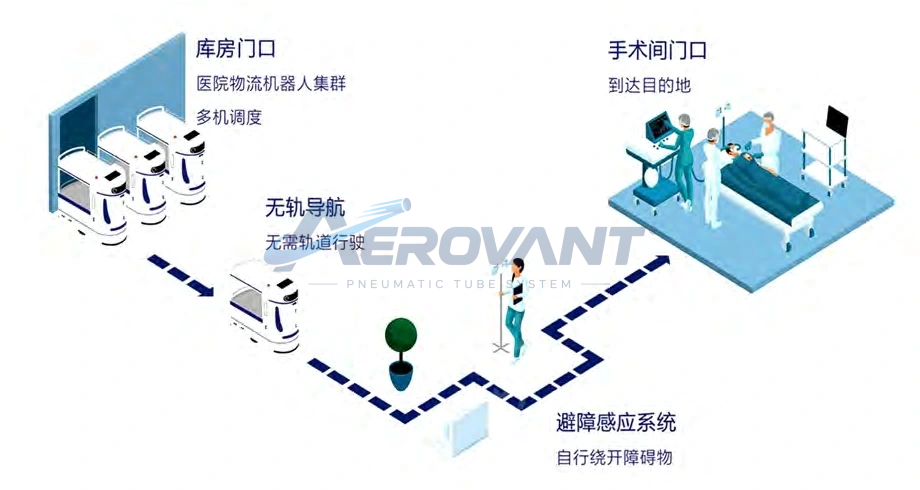
The robot uses obstacle detection and avoidance sensors to navigate operational areas.
Mobile robots for distribution within hospitals.
AGV logistics robots distribute materials within hospitals using navigation without physical rails. The system coordinates robots, pickup points, and delivery locations to support material movement between departments.
Solution overview
The catalogue shows deliveries from warehouses or pharmacies to nurse stations, from food preparation areas to wards, and from warehouses to operating rooms. Managing several robots as a fleet supports delivery scheduling.
Integration with automatic doors, lifts, hospital information systems, and monitoring equipment is described as part of the ecosystem. Integration requirements depend on local infrastructure readiness and workflows.
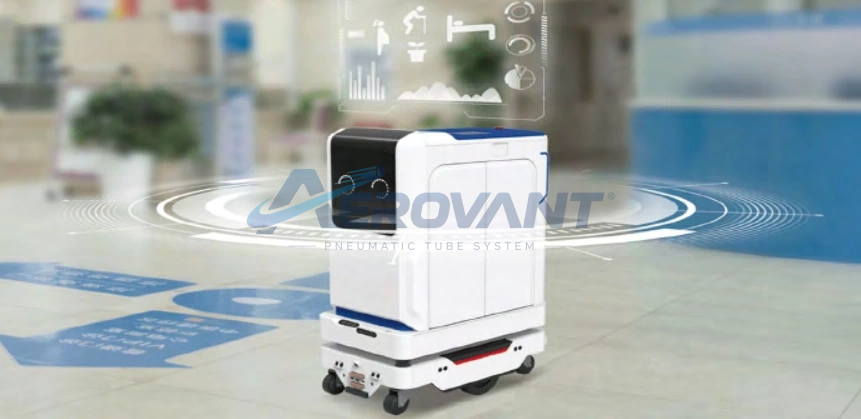
Enlarge ↗Photograph of a logistics robot presented in the system overview.
Features & benefits
The robot uses obstacle detection and avoidance sensors to navigate operational areas.
Supports automatic door opening and closing in integrated building scenarios.
Movement does not require physical floor rails; operational routes still need to be mapped.
Virtual traffic control helps coordinate robot movement in healthcare areas.
Lift integration enables movement between floors according to system settings and building infrastructure.
Robot fleets can be managed to schedule tasks and distribution between departments.
The catalogue lists unattended duty as an operating characteristic.
Loading and unloading functions are described in distribution scenarios that support them.
Robots carry out deliveries to destinations assigned within the system.
How it works
Materials are prepared in the warehouse, pharmacy, or food area. The system assigns the task and the robot that will perform it.
The robot receives its load according to the selected equipment and loading configuration.
The robot follows its route, avoids obstacles, and interacts with integrated doors or lifts.
Materials reach a ward, nurse station, or another department. Unloading and recording follow the system configuration.
 Enlarge ↗
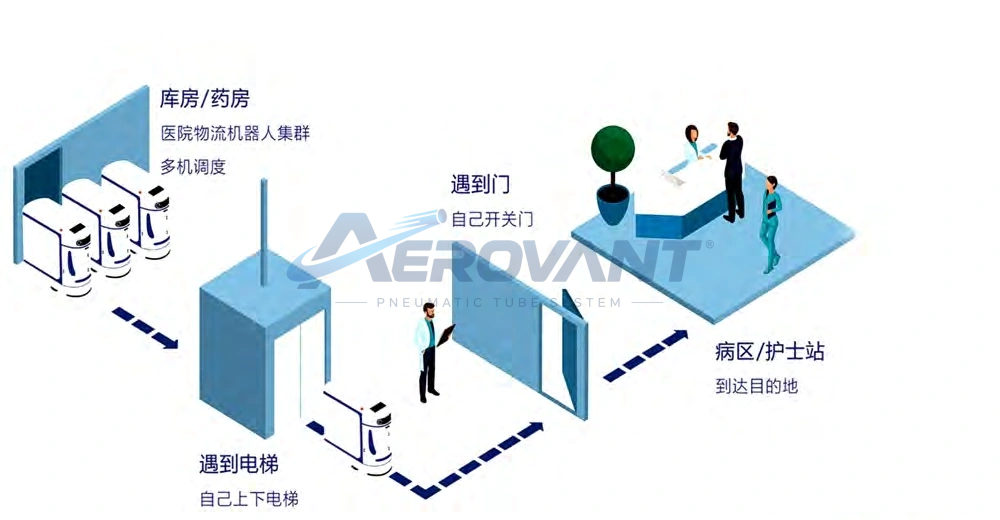
The robot collects materials from a warehouse or pharmacy and passes through integrated doors and lifts to reach a care unit.
 Enlarge ↗
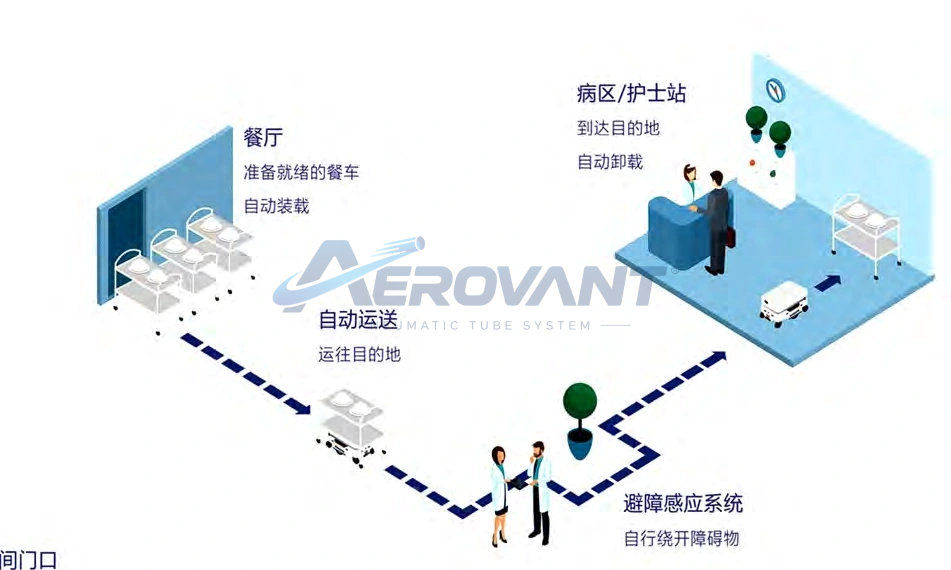
The robot transports meals from the preparation area to a ward while avoiding obstacles along the route.
 Enlarge ↗
Robot fleet scheduling supports material delivery from the warehouse to the operating room area.
System components
Robots are the mobile transport units travelling from origin to destination. Compartments and transfer equipment are selected for the load and intended use.
Enlarge ↗Photograph of a logistics robot presented in the system overview.
The catalogue diagram shows coordination between warehouses or pharmacies, automatic doors, lifts, nurse stations, food areas, and operating rooms for hospital distribution.
Enlarge ↗The robot collects materials from a warehouse or pharmacy and passes through integrated doors and lifts to reach a care unit.
Enlarge ↗The robot transports meals from the preparation area to a ward while avoiding obstacles along the route.
Enlarge ↗Robot fleet scheduling supports material delivery from the warehouse to the operating room area.
Specifications & configuration
The following technical parameters provide an initial guide. Final configuration depends on facility requirements and site conditions.
| Parameter | Details |
|---|---|
| Navigation method | Trackless navigation; virtual traffic control |
| Coordination | Multi-robot scheduling |
| Building interaction | Automatic doors and lifts according to integration |
| Load handling | Automatic loading/unloading on supported configurations |
| Monitoring described in the catalogue | Movement tracking, 360° cameras, and material monitoring |
| Information system | Hospital IT integration and a management dashboard |
| Capacity, dimensions, speed & battery | Not specified in this solution overview; data for the selected model is required |
The catalogue describes support for material monitoring, HIS integration, inventory management, and innovation. Operational benefits depend on configuration and workflow. Savings figures in the catalogue are not presented as Aerovant performance guarantees.
Applications
Application areas can be selected to suit the facility's internal transport requirements.
 Enlarge ↗
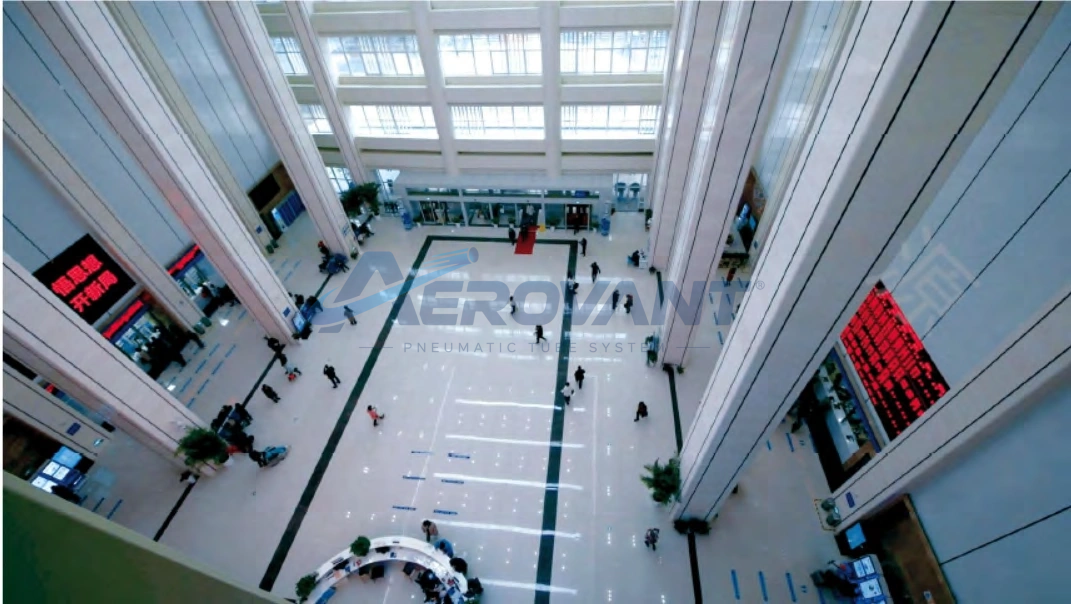
A hospital area shown as an environment for logistics robot use.
Product photographs and diagrams are based on the manufacturer's technical materials.
The Aerovant Ecosystem
Let's get connected
Start by identifying your facility's internal transport requirements.